◎ indicates a movable holiday whose date changes from year to year.
Blue markings indicate customary observances or regional holidays established by local legislation rather than statutory national holidays.
Brazil does not observe a statutory system for substitute holidays when a public holiday falls on a weekend.
B-sect
G-sect
Regional & Specific Holidays
Overview of Public Holidays in Brazil
Saint Sebastian's Day *Rio de Janeiro only Honors Saint Sebastian, the patron saint of the city of Rio de Janeiro.
Anniversary of the Foundation of São Paulo *City of São Paulo only Commemorates the founding of the city of São Paulo on January 25, 1554.
Carnival & Ash Wednesday (Day after Carnival) While not statutory national holidays under federal law, these days are widely observed as official holidays through local ordinances and long-standing social tradition. On Ash Wednesday, many businesses typically remain closed in the morning and open for operations in the afternoon. Carnival originates in the Catholic tradition of Shrovetide. Celebrations run from the Friday preceding Ash Wednesday—the start of Lent, a period of penance and abstinence—through Shrove Tuesday.
Good Friday Observed on the Friday immediately preceding Easter Sunday, this solemn Christian holy day commemorates the crucifixion and death of Jesus Christ.
Tiradentes Day Commemorates the execution of Joaquim José da Silva Xavier, known as Tiradentes (August 16, 1746 – April 21, 1792), a national hero who led an early revolutionary movement for Brazilian independence from Portuguese rule.
Saint George's Day *Rio de Janeiro only Honors Saint George, a widely venerated patron saint in the region.
Corpus Christi A Christian feast day commemorating the institution of the Holy Eucharist at the Last Supper, celebrated on the Thursday 60 days after Easter. Although not a federal statutory holiday, it is widely observed as a day off under local laws and social customs.
Constitutionalist Revolution Day *São Paulo only Commemorates the Constitutionalist Revolution initiated by the citizens of São Paulo on July 9, 1932.
Independence Day Commemorates Prince Pedro's declaration of Brazilian independence from Portugal along the Ipiranga Brook in São Paulo on September 7, 1822.
Our Lady of Aparecida Day Honors Our Lady of Aparecida, the patron saint of Brazil. The holiday commemorates a dark wooden statue of the Virgin Mary venerated since it was retrieved by fishermen from the Paraíba River in 1717.
All Souls' Day A solemn day of prayer and remembrance for the deceased, observed as a feast day in the Catholic Church.
Proclamation of the Republic Commemorates the military coup d'état that deposed Emperor Pedro II and established the Republic of Brazil on November 15, 1889.
Black Awareness Day A national holiday dedicated to honoring Afro-Brazilian heritage and promoting racial equality. It commemorates the death of Zumbi dos Palmares, an iconic resistance leader against slavery, who died on November 20, 1695. Established as a nationwide statutory holiday in 2024.
Evangelical Day *Brasília only A regional holiday dedicated to recognizing Protestant Christian culture and heritage in the Federal District.
National Flag & National Anthem of Brazil
National Flag
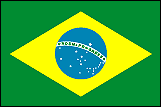
The national flag of Brazil is popularly known as the "Auriverde" (The Gold and Green). The central blue celestial globe depicts the starry sky over Rio de Janeiro as it appeared at 8:30 AM on November 15, 1889—the day the Republic was proclaimed—and features 27 stars representing the states and Federal District. The white banner across the globe bears the national motto, "Ordem e Progresso" (Order and Progress).
National Anthem
The national anthem of Brazil is titled "Hino Nacional Brasileiro." Its lyrics extol the nation's pledge to liberty and sovereignty while celebrating the vibrant beauty and natural majesty of the homeland.