The United Kingdom consists of four constituent countries, and holiday schedules vary by region. On this calendar, nationwide bank holidays are shown in red, while regional holidays are shown in blue.
◎ indicates a movable holiday whose date changes from year to year.
B-sect
G-sect
Y-sect
Overview of UK Public Holidays
Bank Holidays Most public holidays in the UK were originally statutory bank closures, which is why they are officially termed "bank holidays." Even general bank holidays without a specific title often trace their origins to traditional Christian feast days or regional customs.
Good Friday & Easter Monday These holidays commemorate the crucifixion and resurrection of Jesus Christ. Good Friday solemnizes the death of Jesus, while Easter Sunday celebrates his resurrection. The day after Easter (Easter Monday) is also observed as an official holiday in many countries.
Regional Holidays
Public holiday schedules in the UK depend on the region, with Scotland and Northern Ireland observing their own distinct historical and cultural bank holidays.
(Holidays in Scotland)
St. Andrew's Day Honors Saint Andrew, the patron saint of Scotland.
(Holidays in Northern Ireland)
St. Patrick's Day Honors Saint Patrick, the patron saint of Northern Ireland.
Orangemen's Day (Battle of the Boyne) Commemorates the Battle of the Boyne (1690) during the Williamite War, a pivotal event in Irish historical tradition.
UK Flag & National Anthem
National Flag
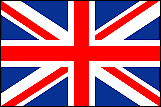
The national flag of the United Kingdom is commonly known as the "Union Jack." Its design combines the heraldic crosses of the patron saints of three historical kingdoms forming the Union: St. George (England), St. Andrew (Scotland), and St. Patrick (Ireland).
National Anthem
The national anthem of the United Kingdom is "God Save the King." The lyrics offer a prayer for the health, long life, and successful reign of the reigning Sovereign.