Holidays marked with ◎ are movable holidays that change dates each year.
In Greece, religious holiday dates are calculated according to the Julian calendar used by Eastern Orthodox churches. Consequently, these dates differ from those observed in Western nations that follow the standard Gregorian calendar.
B-sect
G-sect
Y-sect
Overview of Public Holidays in Greece
In the Greek Orthodox Church, fixed-date observances (such as Epiphany and Christmas) follow the Revised Julian calendar—which aligns with the Gregorian calendar—while the date of Easter continues to be calculated according to the traditional Julian calendar.
Epiphany (Theophany) In Greek Orthodox tradition, Epiphany commemorates the baptism of Jesus by John the Baptist in the Jordan River, during which the Holy Spirit is believed to have descended in the form of a dove. Although celebrated on the same date as Epiphany in Western Christian churches, it commemorates a distinct event.
Clean Monday (Ash Monday / Kathara Deftera) Marks the beginning of Great Lent in the Greek Orthodox Church, occurring 40 days before Easter. Orthodox tradition prescribes fasting from meat starting on this day through Easter.
Independence Day Commemorates the start of the Greek War of Independence in March 1821, which led to Greece's independence from the Ottoman Empire.
Good Friday, Holy Saturday, Easter Sunday, Easter Monday Major religious observances commemorating the crucifixion, burial, and resurrection of Jesus Christ. Because the Greek Orthodox Church determines Easter using the traditional Julian calendar, these dates typically differ from Western Christian Easter.
Pentecost Monday (Monday of the Holy Spirit) A Greek Orthodox holiday commemorating the descent of the Holy Spirit upon the apostles, observed 50 days after Easter.
Dormition of the Holy Virgin (Assumption of Mary) A Greek Orthodox feast day honoring the falling asleep (death) of the Virgin Mary and the translation of her body into heaven.
National Anniversary (Ohi Day) Commemorates October 28, 1940, when Greece rejected the ultimatum issued by Fascist Italy during World War II ("Ohi" meaning "No").
Greece's National Flag & Anthem
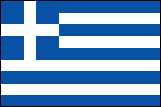
National Flag
The national flag of Greece features nine alternating horizontal blue and white stripes with a white cross on a blue field in the upper hoist corner. The nine stripes represent the nine syllables of the traditional independence motto ("Freedom or Death"), while the cross symbolizes Greek Orthodoxy.
National Anthem
The national anthem of Greece is the "Hymn to Liberty" (Ymnos eis tēn Eleutherian). Its lyrics reflect the struggle and spirit of the 1821 Greek War of Independence against Ottoman rule.