Japan Public Holiday Calendar
Overview of Japanese Public Holidays
- Coming of Age Day
Originating from the traditional coming-of-age ceremony ("Genfuku") held during Little New Year (Koshogatsu), it was originally celebrated on January 15. Under the Happy Monday System, it was moved to the second Monday of January. - National Foundation Day
A day to celebrate the establishment of the nation, historically linked to the accession of Emperor Jimmu. Originally observed as "Kigen-setsu," it was abolished after World War II and later re-established in 1967 as National Foundation Day. - Emperor's Birthday
Celebrates the birthday of the reigning Emperor. The current Emperor, Emperor Naruhito, was born on February 23, 1960. - Vernal Equinox Day
Marks the arrival of spring. The precise date of the vernal equinox is determined based on astronomical calculations published by the National Astronomical Observatory of Japan and finalized by Cabinet decision in February of the preceding year. - Showa Day
Honors the birthday of Emperor Showa. Originally observed as "Greenery Day" from 1990 to 2006, the holiday was renamed "Showa Day" in 2007. - Constitution Memorial Day
Established in 1948 to commemorate the taking effect of the Constitution of Japan on May 3, 1947. - Greenery Day
A national holiday dedicated to appreciating nature, forming part of the Golden Week spring holiday period. The name was transferred here in 2007 when May 4 became a distinct holiday. - Children's Day
Rooted in the traditional Dragon Boat Festival (Tango no Sekku), May 5 was designated as a national holiday in 1948 to celebrate children's happiness and express gratitude toward mothers. - Marine Day
A day to give thanks for the blessings of the ocean and wish for the prosperity of Japan as a maritime nation. It commemorates Emperor Meiji's return to the Port of Yokohama in 1876 after a sea voyage. Formerly observed on July 20, it now falls on the third Monday of July. - Mountain Day
Established in 2016 to provide an opportunity to appreciate Japan's mountains and appreciate their environmental benefits, complementing the earlier creation of Marine Day. - Respect for the Aged Day
Originating shortly after World War II in Hyogo Prefecture as "Old Folks' Day," it became a national holiday in 1966 to honor senior citizens. It is currently observed on the third Monday of September. - Autumnal Equinox Day
A day to honor ancestors and remember the deceased. Like Vernal Equinox Day, the official date is determined based on astronomical data from the National Astronomical Observatory of Japan. - Sports Day
Originally established to commemorate the opening ceremony of the 1964 Tokyo Olympic Games on October 10. Formerly called "Health and Sports Day," it was moved to the second Monday of October under the Happy Monday System. - Culture Day
Commemorates the promulgation of the Constitution of Japan on November 3, 1946. November 3 was historically celebrated as Emperor Meiji's birthday ("Meiji-setsu"). - Labor Thanksgiving Day
Derived from Niiname-sai, an ancient imperial harvest ritual offering new rice to the deities. Following World War II, it was reframed as a national holiday honoring labor and industry.
National Flag & Anthem of Japan
National Flag
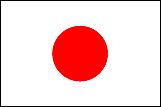
The national flag of Japan is officially designated as the "Nisshoki," commonly referred to as the "Hinomaru" (Circle of the Sun).
National Anthem
The national anthem of Japan is "Kimigayo" (The Emperor's Reign).